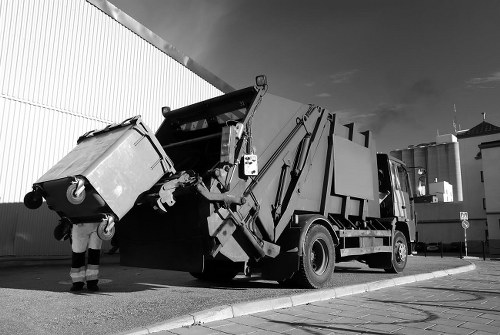
Health and Safety Policy for Commercial Waste Hatch End
Purpose: This policy sets out the standards and procedures that govern safe working for our commercial waste operations in and around Hatch End. It applies to the full range of our rubbish collection and commercial waste services, describing how we manage risks, protect employees, contractors and customers, and maintain safe handling of commercial rubbish, recyclables and general waste. The policy underpins our commitment to continuous improvement and compliance with applicable safety requirements without relying on specific legal detail here.Scope and Objectives
This policy covers all activities associated with commercial waste collection and management, including vehicle operations, depot activities, manual handling, segregation of waste types, and on-site customer interactions for the collection of business rubbish. Our objectives are to prevent injury and ill health, eliminate hazards where practicable, control remaining risks, and provide training, equipment and supervision so that the rubbish company service area operates safely and efficiently.
Responsibilities and Roles
Effective safety depends on clear roles. The senior management team sets policy and resources; supervisors ensure day-to-day compliance; drivers, loaders and depot staff implement safe systems; and every employee is required to report hazards and follow safe working procedures. Key responsibilities include:- Management: policy, risk assessments, resourcing;
- Supervisors: inspections, briefings, incident reporting;
- Employees: use of PPE, safe operation, reporting.
Risk assessment and control are central to our approach. We carry out systematic risk assessments for all activities in the commercial waste service area, including collection routes, customer premises, depot operations and maintenance. Identified hazards such as manual handling, vehicle movements, sharps and hazardous substances are evaluated and controlled through a hierarchy of measures: elimination, substitution, engineering controls, administrative controls and personal protective equipment (PPE). Controls are documented and reviewed regularly to reflect changes in processes or waste streams.
Training and competence form a cornerstone of our safety management. All staff involved in waste collection and recycling services receive induction training, periodic refresher courses and task-specific instruction for equipment such as compactors, balers and lifting aids. Training covers safe lifting techniques, traffic awareness, safe loading of commercial waste vehicles, spill response, and separation of hazardous items. Competence checks and toolbox talks are recorded and monitored to ensure that our rubbish collection teams remain skilled and alert.
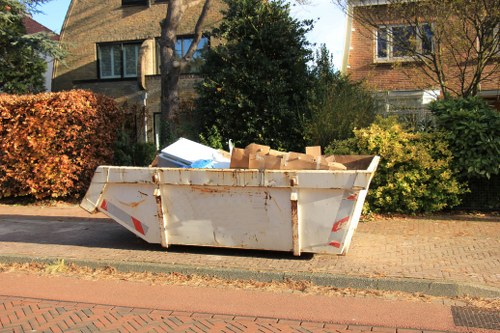 PPE, equipment and vehicle safety: We provide appropriate PPE including gloves, hi-visibility clothing, safety boots and eye protection for operations where risk assessments indicate need. Vehicles are maintained under a planned maintenance schedule to ensure brakes, lights and lifting mechanisms are safe and reliable. Drivers and crew follow vehicle safety checks before each shift and apply loading limits to prevent overloading. We adopt safe reversing procedures and use banksmen or reversing aids where sightlines are limited to reduce vehicle-related incidents in the commercial waste sector.
Manual handling and ergonomics are addressed by combining training, mechanical aids and layout changes to reduce repetitive tasks. For heavier items and bulky commercial rubbish, mechanical lifting aids and trolleys are preferred, and where mechanical handling is impractical, safe lifting techniques are enforced. Staff are encouraged to report any discomfort or near misses to enable early intervention and ergonomic improvements.
 Incident reporting, investigation and emergency response are structured to learn from events and prevent recurrence. All incidents, accidents and near misses are reported promptly, investigated to identify root causes and corrective actions are implemented. Emergency plans cover fuel or chemical spills, fire at depots, vehicle accidents and exposure to hazardous waste. Spill kits, fire-fighting equipment and first aid supplies are located at depots and on vehicles as appropriate.
 Monitoring, review and consultation: The policy is reviewed at defined intervals and following significant changes to operations, incident trends or legislative updates. We maintain records of risk assessments, training, maintenance, incidents and audits to support continuous improvement. Employee consultation is integral: safety committees and toolbox talks provide forums for staff to contribute to safety decisions. Our approach ensures that commercial waste management and rubbish removal services evolve with emerging risks and best practice.
Hazardous and Special Waste Handling
Special waste streams such as chemicals, sharps and electronic waste are segregated and handled under specific procedures to reduce exposure and contamination. Where specialist disposal is required, we ensure that carriers and treatment partners meet required standards. Clear labeling, use of sealed containers and staff training minimise the risk associated with hazardous elements commonly encountered during commercial rubbish collection.Performance and continuous improvement
Performance indicators such as incident rates, training completion, vehicle inspection compliance and audit outcomes are tracked. Lessons learned are fed back into training and procedural updates. We commit to fostering a safety culture where staff are empowered to stop work if they believe an unsafe condition exists and to suggest improvements to enhance the safety of the commercial waste service area.Conclusion: This Health and Safety Policy sets the framework for safe and compliant operation of our commercial waste and rubbish collection activities. By combining risk-based controls, effective training, managed equipment maintenance and active staff engagement we aim to protect people, preserve the environment and deliver reliable commercial waste services. The policy is supported by documented procedures, regular review and a commitment to continuous improvement across all aspects of our rubbish management operations.
