Commercial Waste Hatch End: Recycling and Sustainability
 Commercial Waste Hatch End services are evolving to meet the needs of a greener economy, creating an eco-friendly waste disposal area and a sustainable rubbish area model for local businesses. Our approach to Hatch End commercial waste puts waste prevention, reuse and high-quality recycling at the centre of operations. We work with local businesses across retail, hospitality and small industry to reduce landfill reliance, increase reuse and support the borough's wider environmental objectives.
This sustainable commercial waste strategy sets a clear recycling percentage target: we aim for a 70% recycling rate for commercial waste in Hatch End by 2030, with interim milestones of 50% by 2026 and 60% by 2028. Achieving this target depends on consistent segregation at source, smart collection schedules and investment in local processing. By making small operational changes—improved bin layouts, compacting and baling for paper and card, and separate organic routes for food and garden waste—businesses can meet both regulatory expectations and community sustainability goals.
 The borough's approach to waste separation informs our programmes: many local authorities around Hatch End encourage separate collections for food waste, paper and card, glass, metal, plastic and textiles to ensure cleaner recycling streams. Practical recycling activities relevant to the area include:
- Source-separated paper and cardboard baling for onward recycling.
- Glass and metal segregation to reduce contamination and increase recovery rates.
- Dedicated organic collection for food waste destined for anaerobic digestion.
Local transfer stations play a critical role in turning collected materials into usable secondary resources. Commercial waste Hatch End collections are consolidated at nearby transfer facilities and consolidation hubs where waste is sorted, compacted and transferred to specialist processors. These local transfer stations reduce vehicle miles by handling aggregation close to collection points, which in turn lowers emissions from long-distance hauling and provides a faster turnaround for reusable items that can be donated or reprocessed.
 Partnerships with charities and reuse organisations are central to the sustainable rubbish area concept. We coordinate with local charities, community groups and national reuse networks to divert serviceable goods from the waste stream. Typical charity partnerships include furniture reuse programmes, clothing banks and specialist WEEE (electrical) collectors. Examples of collaboration in the area include working with local community projects, national charities such as the British Heart Foundation for furniture and textiles, and smaller Harrow-based initiatives that refurbish appliances and redistribute them to households in need.
Vehicle emissions are a major contributor to commercial waste footprints, so our Hatch End commercial waste fleet strategy prioritises low-carbon vans and efficient route planning. The fleet comprises electric vans for short urban rounds and hybrid vehicles for longer or heavier loads. Low-carbon vans reduce local air pollution and are paired with consolidation points to minimise trips. In addition, cargo e-bikes and micro-vehicles are used for final-mile collections in denser areas to cut emissions and ease traffic congestion.
Operational Measures to Deliver Results
To maintain momentum toward recycling targets, commercial operators in Hatch End are supported with regular waste audits, staff training and documented waste handling procedures. Hatch End commercial waste services provide clear bin labelling, dedicated loading bay plans and compact storage suitable for segregation into mixed recycling, organics and residual streams. Tracking tonnage by stream helps businesses see progress toward the 70% target and unlock potential savings from reduced disposal costs.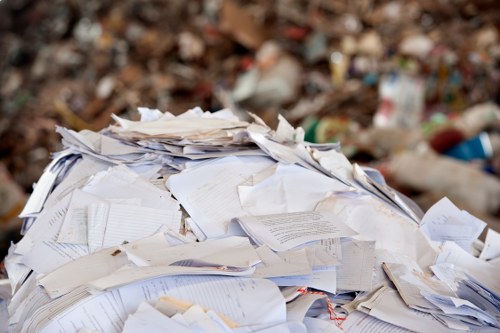 Key actions that form part of a successful sustainable rubbish area include:
- On-site segregation and clear containerisation for recyclables and organics.
- Scheduled reuse pickups coordinated with charity partners to recover furniture, clothing and electronics.
- Use of licensed local transfer stations and consolidation centres to minimise haulage emissions.
- Investment in low-carbon vans and route optimisation software.